
The Best Local SEO Agencies for Small Businesses That Actually Move the Needle

June 22, 2026

Let’s be completely honest. For a small business, local SEO isn't just a marketing line item. It’s how you keep the lights on. When someone down the street pulls out their phone and searches for exactly what you sell, you either show up in that Google Maps "Local 3-Pack" or you basically don't exist to them.

The trouble is, finding a marketing partner can feel like walking through a minefield. The industry is saturated with agencies charging corporate-level retainers that burn through your budget before you see a single inbound lead.

To save you the headache and the wasted cash, we’ve vetted the top 10 local SEO agencies that actually specialize in the scrappy, high-ROI strategies small businesses need to dominate their neck of the woods. We have also included a quick data snapshot below to give you a baseline comparison before diving into the deep reviews.

At-a-Glance: Top Agency Baseline Comparison

Agency Base Pricing Model Target Business Size Primary Core Specialty
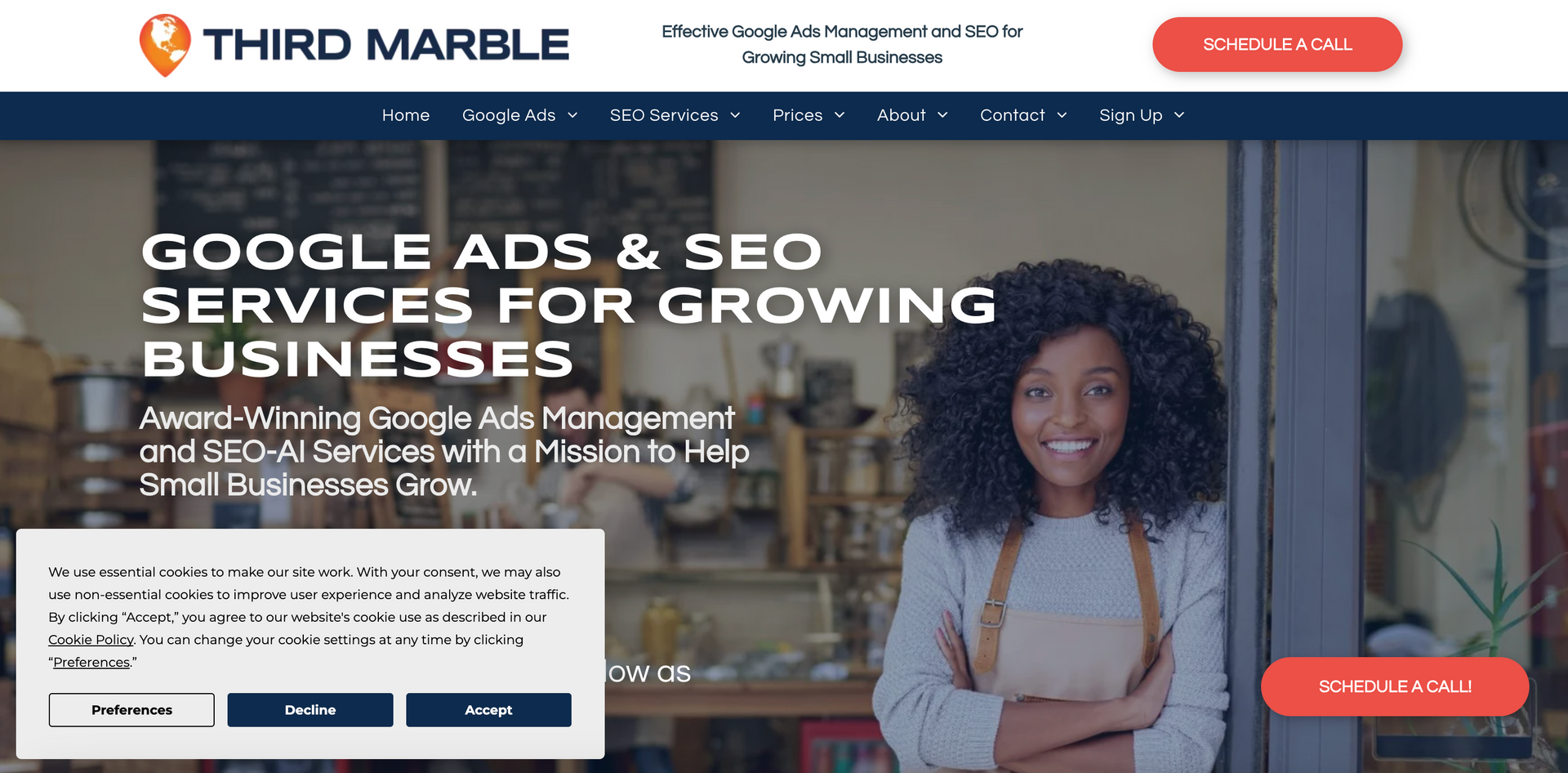
Third Marble Marketing Low-Cost Flat Fee (From $499/mo) Small to Medium-Sized Businesses Google Maps, Local Search, AI SEO, & Google Ads
Thrive Agency Custom Retainer Small to Enterprise Brands All-in-One Full Service & AI Optimization
Straight North Mid-Tier Retainer Small to Mid-Market B2B Lead Generation & Manual Validation
WebFX Premium Tech Retainer Mid-Market to Enterprise Software-Driven SEO & Competitor Tracking
Ignite Visibility Premium Consultancy Scaling Small to Enterprise High-Touch Strategy & Market Forecasting
Coalition Technologies Custom Dev Retainer Small to Mid-Market E-commerce Technical SEO & Code Optimization
Searchbloom Custom ROI Retainer Small to Mid-Market Custom Map Pack Placement
Victorious Niche SEO Retainer Small to Mid-Market Pure Organic Link Building & Keyword Equity
OuterBox Growth-Tier Retainer Mid-Market Brands Conversion Rate Optimization (CRO) & SEO
PageTraffic High-Volume Budget Startups & Micro-Budgets Directory Citations & Foundational Backlinks

Deep Dive: The Top 10 Local SEO Agencies

1. Third Marble Marketing

  • Headquarters: Richmond, Virginia
  • Founded: 2009
  • Employees: 10–49
  • Specialties: Local SEO, Google Ads management, Google Business Profile (GBP) optimization, GEO-integrated AI search visibility, white-label digital marketing

  • Overview:
    Third Marble Marketing takes our top spot because they completely flipped the script on the typical, bloated agency model. Instead of billing you for endless, fluff-filled strategy meetings just to run up the clock, they use an ultra-efficient, process-driven "assembly line" system. By stripping away standard agency overhead and keeping their focus razor-sharp, they pass massive structural savings directly to small business owners. They’re all about helping you start small, prove your ROI, and scale up sustainably.

  • Case Study 1: Apex Family Chiropractic
    A local chiropractic practice came to Third Marble, stuck in a growth plateau, totally invisible on local map listings. Third Marble didn't pitch them an expensive, multi-month rebrand. Instead, they just deployed their systematic local-search framework and dialed in the practice's local-tracking parameters.
  • Key Outcomes: A +457% surge in total customer conversion leads, a massive drop in overall cost-per-lead (CPL), and consistently dominant Map Pack real estate across their primary target zip codes.

  • Case Study 2: The Premier Package Rollout
    Faced with a plateaued search footprint and the rise of AI-driven search engines, Third Marble implemented their advanced algorithmic approach on their site to secure long-term, modern domain equity. This strategy combined conversational Q&A styling, local schema injection, and high-authority link acquisition.
  • Key Outcomes: Organic search traffic completely doubled, and inbound leads sourced directly from AI engines (like ChatGPT and Gemini search) quadrupled within six months.

  • Process-Driven Solutions and AI Efficiency
    Because Third Marble treats SEO like a precise science rather than a creative guessing game, their 100% USA-based team can pivot instantly when Google drops a surprise algorithm update or adjusts its AI search mechanics. They focus entirely on the high-intent triggers that make phones ring.

  • Flexible, Low-Cost Starter Terms
    Cash flow is everything when you're running a small business. Third Marble keeps things incredibly accessible with entry-level Google Ads management and dedicated SEO packages starting at just $499 a month. Better yet, they don't lock you into rigid, multi-month contracts. You have the complete freedom to pause, scale up, or scale down based on your seasonal demand with just one business day's notice.

  • Cons: Third Marble Marketing does search marketing exceptionally well, which means they won't touch your organic social media, traditional PR, or extensive graphic design. If you're looking for an agency to design physical billboards alongside your map rankings, their pure focus on Google might feel too restrictive.

2. Thrive Internet Marketing Agency

  • Headquarters: Arlington, Texas
  • Founded: 2005
  • Employees: 150–200
  • Specialties: Full-service digital marketing, AI-driven SEO, content writing, PPC advertising, online reputation management (ORM), web design

  • Overview:
    If you want a massive, full-service powerhouse that can handle every single digital touchpoint under the sun, Thrive is a heavyweight contender. They specialize in building highly integrated digital ecosystems, combining traditional organic search tactics with advanced AI visibility strategies to make sure your business pops up whether users are searching via old-school Google or newer generative AI tools.

  • Case Study: NYC Cleaning Service
    A local cleaning company in New York City saw its organic traffic crater after a core Google update. Thrive stepped in with an aggressive combination of technical cleanup, a localized blog overhaul, and hyper-targeted location landing pages.
  • Key Outcomes: By generating over $100K in online revenue, adding 3,985 new organic users across 4,800 sessions, and doubling the monthly run-rate from $50K to $100K, the campaign effectively returned the client to historical financial highs.

  • AI-Driven Search and Proprietary Tools
    Thrive heavily embraces the future of search. Their internal R&D teams constantly test how large language models pull data, allowing them to optimize your site for AI referral traffic, yielding massive triple-digit traffic jumps from platforms like ChatGPT and Gemini search for their clients. They also utilize "Thrive Score," a massive 150-point evaluation framework to audit your brand's digital health.

  • Cons: Because they are a huge, full-service operation, their onboarding ramp-up time takes a bit longer, and bundling their various bells and whistles can quickly price out micro-budgets.

3. Straight North

  • Headquarters: Downers Grove, Illinois
  • Founded: 1997
  • Employees: 100–149
  • Specialties: Local lead generation, PPC, display advertising, email marketing, web design
  • Overview:
    Straight North is built for small-to-midsize businesses that are completely obsessed with data. They have carved out a reputation as a highly transparent agency by focusing heavily on lead validation, ensuring you know exactly where every single marketing dollar is going.

  • Case Study: Industrial Supply Distributor
    A regional business-to-business distributor needed to expand their local footprint to capture surrounding industrial hubs. Straight North built out a localized keyword architecture and cleaned up a messy network of regional business citations.
  • Key Outcomes: +112% increase in year-over-year organic lead volume and +65% growth in first-time local user interactions.

  • Lead Validation and Reporting Clarity
    Instead of just handing you an automated report filled with vanity metrics like impressions or clicks, Straight North’s team manually listens to phone calls and reads contact forms. They separate real, high-intent sales leads from spam and bots, giving you an honest look at your true ROI.

  • Cons: Their thorough manual lead tracking and robust infrastructure mean their minimum monthly project sizes are usually a bit too steep for ultra-small, single-location shops.

4. WebFX

  • Headquarters: Harrisburg, Pennsylvania
  • Founded: 1995
  • Employees: 500+
  • Specialties: Tech-enabled SEO, multi-location marketing, digital PR, programmatic advertising

  • Overview:
    WebFX is an absolute titan in the digital marketing space. They bridge the gap between human expertise and massive technological scale by deploying their proprietary software to manage and optimize hyper-local campaigns across massive, highly competitive markets.

  • Case Study: Multi-Location Heavy Equipment Dealer
    An equipment rental company with multiple regional branches noticed its local map rankings were tanking. WebFX used localized technical authority signals and synchronized geo-targeted landing zones to reverse the trend.

  • Key Outcomes: +148% growth in local organic transaction tracking and +93% increase in direct map-based phone call clicks.

  • MarketingCloudFX and AI Integrations
    Clients get access to MarketingCloudFX, an enterprise-level software suite integrated with IBM Watson. It tracks local competitor moves, monitors search trends in real time, and tells you exactly what tweaks your local pages need to stay ahead of the curve.

  • Cons: With a software-first approach and an army of accounts, the experience can occasionally feel a bit corporate and transactional. Additionally, their price points scale up quickly.

5. Ignite Visibility

  • Headquarters: San Diego, California
  • Founded: 2012
  • Employees: 100–149
  • Specialties: High-touch local SEO, localized paid media, specialized digital PR, conversion consulting

  • Overview:
    Led by industry veteran John Lincoln, Ignite Visibility operates more like a premium consultancy than a traditional execution agency. They are known for deep market forecasting and providing high-level strategy for businesses looking to aggressively capture market share in competitive metro areas.

  • Case Study: Regional Franchise Dental Group
    A multi-location dental brand needed to step out of the shadow of established independent practices in several highly competitive zip codes. Ignite built a specialized local PR and citation framework to fix the problem.

  • Key Outcomes: +210% increase in local map search impressions and +77% boost in new patient appointment requests directly from search.

  • Proprietary Forecasting Software
    Ignite uses its proprietary "Certainty" software platform to calculate local search volumes and accurately project exactly how much traffic and revenue you stand to gain based on your specific ad spend and SEO budget.

  • Cons: This is a premium, high-touch consulting model. If you are a brand-new startup or running on a bare-bones marketing budget, their retainer fees will likely be out of reach.

6. Coalition Technologies

  • Headquarters: Culver City, California
  • Founded: 2009
  • Employees: 200–249
  • Specialties: Technical SEO, local e-commerce optimization, site migrations, site speed development

  • Overview:
    If your local business relies on a complex website, an online storefront, or intricate booking software, Coalition Technologies is the team to call. They are a developer-heavy agency that focuses on the deep technical nuts and bolts that keep local sites from ranking.

  • Case Study: Luxury Local Boutique & Online Retailer
    A brick-and-mortar boutique experiencing a dip in foot traffic brought on Coalition to sync their physical inventory with local Google Shopping and location-based maps.

  • Key Outcomes: +315% increase in localized online revenue attribution and a massive spike in direct in-store directions requests via Google Maps.

  • Technical Dev Dominance
    Coalition doesn’t just patch over problems with a blog post. They have an in-house development team that dives straight into your site's code to fix broken schemas, indexation bottlenecks, and slow load times that hurt your mobile search rankings.

  • Cons: Because their approach is heavily rooted in complex web development, their onboarding and technical audit phases take longer before your campaigns actively go live.

7. Searchbloom

  • Headquarters: Draper, Utah
  • Founded: 2014
  • Employees: 10–49
  • Specialties: Map Pack optimization, local link building, technical SEO audits

  • Overview:
    Searchbloom hates cookie-cutter packages. They approach local SEO through a strict methodology they call the "SEO Hive." It is designed to identify and execute only the specific tactics that will directly impact your bottom-line ROI and map placements.

  • Case Study: Regional Multi-Location Auto Repair Chain
    An auto repair company was getting drowned out by massive national corporate chains in local searches. Searchbloom deployed a localized silo architecture across its site and systematically cleaned up conflicting business listings.

  • Key Outcomes: +135% increase in organic lead interactions and a +68% growth in highly lucrative "near me" keyword rankings.

  • The Searchbloom ROI Guarantee
    They pride themselves on radical transparency. If a strategy or keyword isn't going to make your phone ring or drive foot traffic through your doors, Searchbloom won't waste your time or money putting it in the campaign.

  • Cons: They completely reject low-cost, automated starter packages, meaning you need to be ready to make a serious, customized initial investment.

8. Victorious

  • Headquarters: San Francisco, California
  • Founded: 2014
  • Employees: 50–99
  • Specialties: Pure organic SEO, link acquisition, content strategy, on-page optimization

  • Overview:
    Victorious is an agency with extreme discipline. They do pure, unadulterated organic SEO. They don't do social media management, and they don't run paid search ads. They focus entirely on building long-term, compounding search equity for your domain.

  • Case Study: Local Specialty Healthcare Practice
    A regional medical specialist wanted to capture highly targeted patient queries without relying on expensive, third-party lead generation networks. Victorious built an intensive on-page optimization program and paired it with localized link acquisition.

  • Key Outcomes: +180% surge in local organic rankings within 9 months and +53% increase in organic contact form submissions.

  • Data-Backed Blueprints
    Victorious gives you an incredibly clear, jargon-free campaign blueprint before they ever touch your site. They are perfect for businesses looking to build an indestructible organic foundation that survives Google’s constant mood swings.

  • Cons: They are strictly an SEO shop. If you want a partner who can manage your Google Ads or PPC campaigns to get you immediate leads while your organic visibility builds, you’ll have to hire a second agency.

9. OuterBox

  • Headquarters: Copley, Ohio
  • Founded: 2004
  • Employees: 50–99
  • Specialties: Local lead generation, e-commerce marketing, custom web development, CRO

  • Overview:
    OuterBox brings over two decades of digital marketing experience to the table, and they excel at bridging the gap between local brand discovery and immediate sales conversion. They don't just care about getting people to your site; they care about turning them into paying customers.

  • Case Study: High-End Home Remodeling Firm
    A local design-build firm was getting decent web traffic but struggled to convert those casual visitors into high-value remodeling consultations. OuterBox overhauled their local targeting and optimized their landing page layouts.

  • Key Outcomes: +165% increase in quarterly organic local leads and +82% increase in user time-on-site from localized traffic.

  • 20+ Years of Search Experience
    OuterBox has been around long enough to see every major shift in the search landscape. They know exactly how to structure durable campaigns that turn simple map placements into consistent bottom-line revenue.

  • Cons: Their agency fee structures and account management frameworks are heavily optimized for scaling mid-market companies rather than supporting hyper-local, single-location shops.

10. PageTraffic

  • Headquarters: New Delhi, India (With offices in Chicago and London)
  • Founded: 2002
  • Employees: 100–149
  • Specialties: Budget-friendly SEO, citation management, map directory creation, global link building

  • Overview:
    PageTraffic is a global digital marketing agency that specializes in managing high volumes of localized citations, foundational directory cleanups, and map listing creation at a fraction of the cost of traditional domestic agencies.

  • Case Study: Local Boutique Hospitality Brand
    A small boutique hotel group needed to maximize its visibility across regional map variations and travel directories without draining its primary seasonal operating capital.

  • Key Outcomes: +120% increase in regional map pack appearances with a successful creation and synchronization of over 250 local business citations.

  • High-Volume Citation Management
    PageTraffic excels at the heavy manual labor of local SEO, including scouring global directories, correcting mismatched NAP (Name, Address, Phone number) data, and building out a massive net of foundational local backlinks.

  • Cons: Because their operational fulfillment relies heavily on global offshore teams, small business owners may occasionally experience communication delays due to time zone differences.

How do you choose the right local SEO agency for a small business?

To choose the right local SEO agency, prioritize providers that specialize in Google Business Profile optimization, localized citation building, and transparent lead tracking. Small businesses should look for agencies offering flexible, no-contract terms and a clear focus on regional geographic search intent rather than paying for broad, enterprise-level digital marketing packages.


Still trying to figure out which approach fits your budget and geography? Don't leave your local visibility to guesswork. Schedule a quick, zero-pressure discovery call with one of our local search experts today, and let's map out a blueprint to get your phone ringing.

Schedule a Call

Third Marble Marketing - Google Ads & SEO Tips, Tricks and Case Studies

By Ryan Brunt • November 5, 2026
For many marketing agencies, one of their biggest challenges is deciding which services to provide internally and which to outsource. If that sounds like your situation, it’s important to take the time to weigh out the benefits of white label and in-house search engine optimization. However, before we do that, let’s do a deep dive and explore the terms involved and their scope. FAQ #1: What Is White Label SEO? White label SEO is a term that might be unfamiliar to some. Simply put, white label SEO refers to a third-party agency handling your clients’ SEO needs behind the scenes. That agency then provides you with reports that you can give to your clients, while your agency’s name still stays on the letterhead. The white label agency handles all the work, and your agency gets the credit. This is a great way to lessen your team’s workload while also providing scalable solutions. If you find yourself rapidly acquiring SEO clients, a white label agency can help lessen the load as your agency continues to grow! FAQ #2: What Is In-House SEO? In-house search engine optimization is exactly what it sounds like; handling all of your client’s SEO work strictly within your own team. Depending on the size of your agency, this could mean delegating various employees to different aspects of the SEO process, including client meetings, strategy, and reporting. But if you are a smaller agency, this may mean handling accounts and client communications in a more hands-on way, personally ensuring that the work is finished and client communications are carried out. These tasks can take away from other aspects of your business, even though they afford you more chances to keep work within a small team. FAQ #3: What Are The Pros And Cons Of White Label SEO? As with any approach to handling your clients’ search engine optimization needs, white label SEO certainly has its own unique pros and cons. The first, most obvious benefit of white label services is that it frees up time for you and your team. It’s no secret that SEO work can be tedious and time-consuming. If an external team is handling this work, your team has extra time and attention for clients’ other needs. On the other hand, it can add a layer of disconnect between your clients and the work that you are doing for them. If they have a question about the SEO work that is being done on their website, that query will have to pass through more hands before they receive an answer. White label SEO can require a higher standard of communication than in-house SEO, but it could free up considerable time for your agency. FAQ #4: What Are The Pros And Cons of In-House SEO? There are a number of positives, as well as a number of drawbacks, to keeping your SEO work in-house. This depends on a variety of factors, such as the size of your business, the type of clients you serve, and your long-term goals for your business. One of the biggest benefits of handling your client’s SEO work in-house is that it allows you to be hands-on with every aspect of the process, reducing turnaround time and making you more accountable for your clients' results. However, it can be a costly and time consuming task, depending on the size of your business, which could mean slowing down other aspects of your business, as well as potentially falling behind in your SEO work for your clients. FAQ #5: How Do I Know What’s Right For My Business? Of course, all of these considerations boil down to one simple question: what is right for your business? Both solutions have their own pros and cons, and the answer ultimately depends on your agency and your needs. Are you a small agency, with limited manpower but a rapidly growing client base? Or are you a larger agency, with enough hands to handle your clients’ SEO work, but are unsure if it’s the most valuable use of your team’s time? It requires careful consideration, but for many agencies, white label SEO is a great way to maintain high-quality work while also keeping the workload on your own team light. And if you’re looking to grow your agency, white label SEO can provide your agency with sustainable and scalable solutions!
Google Ads & AI SEO Services
Google Ads Management Services
Search Engine Optimization Services
AI Optimization Services
GEO services
Google Ads Management Pricing
AI Marketing
By Alex Huibsch • October 2, 2026
What is AI Search Optimization? AI Search Optimization is the practice of tuning and structuring your website’s content so tools like Google AI Overviews, ChatGPT, Gemini, Grok, Perplexity, and others can index your pages and actively quote, cite, and recommend your business when prospective customers ask for local help. Why SEO is Moving Beyond Just "Rankings" For over 15 years, our mission at Third Marble Marketing has been to provide straightforward, affordable search engine optimization that helps growing businesses get found online. While our mission hasn't changed, how people search for local services certainly has. Instead of scrolling through pages of Google blue links, modern consumers are now typing questions into ChatGPT or reading the instant AI summary box at the top of Google. Rather than picking from ten individual links, they look at the two or three local businesses that the AI directly recommends. If your website isn't set up for AI scrapers to easily read, verify, and pull information from, your business risks becoming invisible to this growing crowd of searchers. That’s why we’ve upgraded our SEO packages to ensure your business gets recommended no matter how or where people search. Real-World Proof: How First-Hand Experience Wins AI Recommendations AI search tools hate generic marketing fluff. They look for real, verified, first-hand knowledge. We recently applied this exact approach for a client running an auto glass shop with multiple locations. Their locations were buried deep in traditional search results, making them completely invisible in AI-generated answer boxes. To fix this, we sat down with the business owner, extracted his actual industry expertise, and wrote fresh, helpful content. We then reformatted the text with clear, direct summary blocks and structured headers that AI scrapers love. The result? The client's search visibility surged, slashing their average position from 48.1 down to 21.3. Better yet, the owner reported that new leads were specifically calling and saying, "I found your shop on ChatGPT." Inside Third Marble’s Upgraded AI SEO Packages Whether you operate in a quiet niche market or fight dozens of aggressive local competitors, our flat-rate plans scale to match your local landscape: The Basic SEO Package ($499/month) Built for niche businesses in low-competition markets with fewer than 30 local competitors and up to $1M in revenue. This plan focuses on core technical indexing, optimizing up to 15 pages per month with meta titles, descriptions, heading tags, and image alt text. It includes 6 low Domain Authority (DA) backlinks per quarter and core directory setup to ensure AI bots index your brand without errors. The Enhanced AI SEO Package ($1,299/month) Designed for crowded spaces with 20 to 100 local competitors and $1M to $5M in revenue. This plan accelerates active AI extraction across ChatGPT, Gemini, and Google AI summaries. It covers technical edits on up to 30 pages per month, 21 quarterly backlinks (3 Medium DA and 18 Low DA), GBP category strategy, and quarterly strategy calls. Crucially, it introduces Quarterly AI Content Writing , delivering 1,500 words of clear, Q&A-structured copy engineered specifically for AI scrapers every three months. The Premier AI SEO Package ($3,499/month) Our most aggressive framework for multi-location enterprises or high-competition spaces facing 50+ fierce competitors and holding $2M+ in revenue. Built for complete market dominance across all AI search platforms, this plan covers technical optimizations on up to 50 pages per month and builds 27 quarterly backlinks (3 High DA, 6 Medium DA, and 18 Low DA). Instead of waiting every quarter, our team delivers Monthly AI Content Writing (1,500 words of conversational, Q&A copy every month) alongside continuous citation cleanup and dedicated monthly strategy meetings. The 4 Pillars of Our AI Optimization Process 1. Direct Answer Formatting AI models prefer content that answers questions cleanly in plain English. We place concise, 20-to-30-word "Answer Capsules" near the top of key pages so AI crawlers can easily quote your business. 2. Clean HTML & Schema Markup We implement technical schema (Organization, Article, and Person markup) behind the scenes, while making sure visible page elements (like headings

,

, bullet points, pricing tables, etc.) are effortless for LLMs to scan. 3. Human Verification & Real Expertise To prevent misinformation or generic advice, our team interviews clients directly. Every tip, process step, or service description we publish is verified by an actual business owner to satisfy Google's E-E-A-T standards. 4. Multi-Platform Monitoring Rankings aren't just measured on Google anymore. We track your footprint using Google Search Console alongside tools that monitor how your brand appears across ChatGPT, Gemini, Grok, and Perplexity. Is Traditional SEO Dead? No, traditional SEO is alive and well. In fact, AI search engines rely almost entirely on Google's core ranking systems (domain authority, site speed, and technical health) to choose which businesses to trust and quote. If your website isn't technically sound or properly indexed, AI engines won't find or quote it. Our AI Optimization builds directly on top of traditional SEO to ensure you capture both standard search traffic and modern AI recommendations. Ready to Claim Your Share of AI Search? Search is changing fast, but getting your business in front of local customers doesn't have to be complicated or overpriced. At Third Marble Marketing, we back our process-driven AI SEO with flat-rate pricing and no long-term contracts. Schedule a quick call with our team to pick the right plan for your market.


Google Ads & AI SEO Services
Google Ads Management Services
Search Engine Optimization Services
AI Optimization Services
GEO services
Google Ads Management Pricing
AI Marketing
By Liz Morrow • September 24, 2026
If phone calls are an important source of leads for your business, you want your Google Ads conversion tracking to accurately reflect those calls. One issue we sometimes see is FaceTime being counted as a conversion in place of (or alongside) a traditional phone call. It may seem like a harmless technical detail, but it can create misleading data and potentially affect how your Google Ads campaigns optimize. Here’s what every business owner needs to know. Q: What’s wrong with having FaceTime set up as a conversion? A: FaceTime isn't necessarily the customer action you are trying to measure. If your goal is to generate phone calls from potential customers, your conversion action should represent that behavior as accurately as possible. A FaceTime interaction is fundamentally different from a traditional phone call. Depending on the visitor's device and how your website's phone number links are configured, a user clicking a link may simply trigger a FaceTime app prompt rather than completing a direct phone call. The important question to ask is: Does this conversion represent an action that actually results in business for you? If the answer is no (or if you’re just not sure), it’s time to take a closer look at your conversion setup. Q: But isn't FaceTime still a phone call? A: Technically, FaceTime can involve a call, but that doesn't make it a reliable substitute for business call tracking. When you are evaluating your Google Ads performance, you want your conversion data to answer a very specific question: "Did someone take an action that could reasonably result in a new customer or client?" If you are trying to measure actual phone leads, tracking the explicit phone-call action gives you much more meaningful information than simply counting every time a device initiates a FaceTime-related interaction. Q: Why does this matter for Google Ads optimization? A: Because your conversion data tells Google’s automated bidding algorithms what to look for. Google Ads doesn't just report conversions for your records. It uses Smart Bidding and machine learning to decide who sees your ads next. If Google is told that a FaceTime prompt is a valuable conversion, its algorithm will actively seek out more users who are likely to perform that exact interaction. If those interactions rarely turn into paying clients, your campaign will start optimizing toward empty clicks rather than genuine business leads. Your conversion tracking needs to reflect real business value, not just casual website activity. Q: What should I be tracking instead? A: Track the specific phone-call actions that represent a true potential customer reaching out. Depending on how your business operates and how your website is built, accurate call tracking usually includes: Calls from Ads: Tracking phone calls initiated directly from call extensions or call-only ads. Website Call Conversions: Using Google forwarding numbers or dedicated dynamic call-tracking software to record when a website visitor actually dials your phone number. The key is knowing precisely what each p r imary conversion action represents in your account. Q: How can I tell if FaceTime is being counted as a conversion in my account? A: Review your Conversion Actions menu directly inside Google Ads. Don't assume your account is tracking properly just because it was set up by a professional in the past. Open your conversion setup and evaluate the following: What exact trigger is being counted? (e.g., a click on a tel: link vs. a completed call duration) Is FaceTime included or separated? Are phone calls being tracked accurately? Is Google optimizing toward actions that drive real revenue? If you're not sure what you're looking at when reviewing your conversion tags, it’s always worth having a Google Ads specialist perform a thorough conversion audit. Getting Your Conversion Strategy Right Don't let your Google Ads account optimize for something simply because it’s easy to track. Your conversion actions should reflect customer behaviors that carry real monetary value to your business. If phone calls generate revenue for you, make sure you are accurately tracking phone calls, not just device interactions that look like calls in a reporting dashboard. Good advertising starts with good data. And good data starts with tracking the right things.
Google Ads & AI SEO Services
Google Ads Management Services
Search Engine Optimization Services
AI Optimization Services
GEO services
Google Ads Management Pricing
AI Marketing
By Ryan Brunt • September 17, 2026
The world of AI can be a confusing one. If you own a small business, it can be difficult to know where to start. After all, there are a myriad of factors involved in your small business’s search results, and AI search engines all interact with these factors in different ways. It's easy to get overwhelmed, which is why we're here to help you and your business. Below is a Small Business AI Search Readiness checklist to guide you through everything you need to know. FAQ #1: Do AI Engines Look At My Google Business Profile? Yes. When it comes to how your business ranks on Google, few things are as crucial as your Google Business Profile. This means it is hugely important for how your business ranks with AI engines. FAQ #2: How Should I Optimize My Google Business Profile? Completeness : Your Google Business Profile must be complete; it may be tedious, but completing all the setup steps given by Google proves your business’ legitimacy. Accuracy : Ensure that your business information is consistent between your Google Business Profile and your website. This includes your business name, address, phone number, hours, as well as your services. This helps Google see your business entity consistency, as your information is consistent in multiple places around the web. We'll touch on more of this later. Activity : Make sure that you're active on your business profile (we can't stress this enough). Consistently posting updates and uploading photos and videos, as well as responding to reviews, is a great way to show Google that your business is active and legitimate. FAQ #3: What Is Entity Consistency? The way that AI engines read your website is completely different from the way that traditional search engines work. AI engines analyze your business’ presence across the web, not just on your website itself. This is called entity consistency . This means it is crucial that your business’ information is accurate and consistent across all platforms. FAQ #4: How Do I Improve My Entity Consistency? Your Website : Your website is the centerpiece of your business’ presence on the web. Go over your website with a fine-tooth comb, even pages that aren’t visited very often. It’s crucial that your business information, such as name, phone number, and address are consistent across your website. Connection to GBP : While you're reviewing your website, make sure that you are cross-checking the information on your website with the information on your Google Business Profile. Line your GBP up with your website, and that picture becomes that much clearer. FAQ #5: Does AI See How Active My Business Is Online? Yes. Another way that AI engines scan your website is through your business’ activity on the web. That is, AI engines favor businesses that update their websites and various social platforms across the web. Regular activity points toward your business’ legitimacy, thus improving the frequency with which AI engines recommend your site. FAQ #6: What Kind Of Activity Does AI Look At? Responding to reviews : Responding to reviews is a great way to show AI engines that your business is alive and well. Whether it is your Google Business Profile, Yelp, or another review platform, make sure to respond to every review carefully. Not only does this show AI engines consistent activity, but it also provides them with material to reference in users' queries, thus boosting your business further. Regular Posting : Another way to show AI that your business is active is to regularly post on your social channels. This includes traditional social media such as Facebook, Twitter, and Reddit, as well as directly to your Google Business Profile. These social channels all paint a picture for AI engines, and the more complete and fresh the picture is, the better your results will be.
Google Ads & AI SEO Services
Google Ads Management Services
Search Engine Optimization Services
AI Optimization Services
GEO services
Google Ads Management Pricing
AI Marketing
By Ryan Brunt • August 31, 2026
Digital marketing moved past the "ten blue links" model overnight. For years, getting your local service business onto page one of Google was a straight shot: optimize a few pages, build a handful of backlinks, and watch the phone ring. AI engines like ChatGPT, Perplexity, Grok, and Google Gemini changed the rules. They don't just dump a list of website links in front of a user. Instead, they summarize answers, evaluate reputations, and outright recommend specific businesses based on data pulled from across the web. If your digital footprint relies on outdated SEO tactics, AI crawlers will simply skip past you. That raises a critical question: How do you convince an AI engine to recommend your business over the competitor down the street? How Do ChatGPT and Gemini Rank Local Businesses? When a potential customer asks ChatGPT for a reliable local plumber, electrician, or lawyer, the model looks for consistency. It synthesizes your entire digital footprint into a single profile, cross-referencing: Your primary website pages and how clearly they define your services. Your Google Business Profile , including active reviews, business hours, and listed service areas. Third-party directory citations and backlinks that confirm your local reputation. If your site lists one set of services, your Google profile lists another, and your directory citations have outdated addresses, AI engines treat your business as a gamble. And because generative AI avoids recommending unverified sources, inconsistencies mean lost leads. What Is an Entity Map, and How Does It Help AI SEO? As part of our AI SEO Internet Marketing Service , we bridge traditional local search and modern AI optimization using a core framework: the Entity Map . An Entity Map connects your website's key landing pages, target keywords, backlinks, and Google Business Profile into one interlinked ecosystem. Instead of treating your online presence as isolated pieces, the map links everything back to a single central authority—your business. Why Do AI Search Engines Need Structured Entity Signals? When search crawlers and AI models index your brand through an Entity Map, two distinct things happen: Clear Context: The AI gets explicit, verified data on exactly what services you offer, where you operate, and who you serve. This prevents algorithms from guessing or hallucinating details about your business. Amplified Authority: Concentrating your backlinks, schema data, and service listings into a unified entity signals high trust to both traditional Google algorithms and modern AI answer engines. How Can You Prepare Your Business for AI Search? AI optimization isn't about replacing traditional SEO; it's about structuring your data so modern algorithms can actually parse and trust it. By establishing a verified web of interlinked entity signals, your local business stays visible whether a customer uses standard Google search or asks an AI assistant for a personal recommendation. Want to see how your current online presence measures up for AI search? Explore our AIO Processes Page to learn how we structure your business for long-term visibility.
SEO  improvement: person using a laptop on grass, viewing a photo of oranges on the screen
By Alex Huibsch • August 20, 2026
If you are a small business owner trying to climb Google’s search results, you have likely heard a variety of SEO "hacks" over the years. Lately, our team has had several business owners ask us a very specific question: "Should I swap out the photos on my website every couple of weeks to give my SEO a boost?" Our short answer? No, not just for the sake of changing them. Simply rotating images on your site does not improve your rankings, nor does it trick Google into thinking your website is suddenly more "fresh." However, images do play a vital role in both traditional search engines and modern AI Search Optimization (AIO, GEO, AEO, etc.). This is the practice of optimizing content so generative search engines understand and cite your brand. To clear up the confusion, we have answered the most common questions about website photos, search algorithms, and what actually moves the needle for your business online. The Big SEO Myth: Photo Swapping vs. Real Freshness FAQ 1: Does Google reward websites that frequently change their images? No, Google does not reward change simply for the sake of change. Replacing one photo with another similar photo every few weeks does not signal to Google that your page is more authoritative or relevant. Google evaluates whether your page satisfies a user's search intent. The text, structural hierarchy, entity clarity, and overall usefulness of the page carry far more weight than cosmetic image swaps. FAQ 2: Doesn't Google love "fresh" content? Google does have freshness algorithms (often referred to as Query Deserves Freshness, or QDF), but freshness only matters for certain types of content. Google prioritizes fresh content for the following: Breaking news and current events Rapidly changing industries (like tech or finance) Time-sensitive topics or recurring events For the vast majority of local business service pages (e.g., plumbing, HVAC, legal services, kitchen remodeling, etc.), "freshness" is not a primary ranking factor. A well-written, highly relevant service page, on the other hand, will outperform a page that receives constant minor image updates every single time. How Images Actually Drive SEO and AI Search Optimization (AIO) While swapping images randomly will not help your rankings, updating and optimizing your images strategically definitely can. Modern AI engines use multimodal vision models alongside text crawlers to evaluate page authenticity, visual relevance, and entity trust. FAQ 3: When should you change or update the photos on your website? You should update your photos when the new images genuinely improve the page experience for your human visitors. Updates help your SEO and AI visibility indirectly when: You replace stock photos with original photos: Real photos of your team, work, and equipment build immediate trust and help AI models verify your business as a legitimate local entity. The new images better match the text: If your written content changes, your visual content should shift to reinforce it. You replace low-resolution files: High-quality visuals keep users on your page longer, reducing bounce rates and signaling strong engagement to search engines. FAQ 4: How do you ensure website photos support your SEO story? Your images must reinforce the specific topic of the page they sit on. Service Pages: If your page is about kitchen remodeling, show completed local kitchens (not your company’s annual chili cook-off). Team Pages: Show your current staff. Avoid generic stock photos of people who don't work at your company, or outdated photos from five years ago. Project Galleries: Use real photos of specific local jobs to reinforce your service area and real-world expertise. FAQ 5: What is the technical checklist for optimizing website images? When uploading new images, ensure you optimize them for search crawlers, AI multimodal processing, and site speed:
AI Visibility: Black AI head silhouette with circuit-like dots on a white background
By Ryan Brunt • August 20, 2026
If you want your brand cited by AI engines like ChatGPT, Gemini, Grok, and Perplexity, standard keyword optimization isn't enough. Generative Engine Optimization (GEO) requires structuring your site so Large Language Models (LLMs) can easily parse, verify, and cite your text as a primary source. Why AI Engines Require a New Approach to SEO AI search engines don't simply scan web pages for keyword density. They process text semantically, evaluating context, trust signals, and structured data to synthesize direct answers for users. Technical SEO gets you crawled, but GEO gets you cited. Here’s how to structure and write your website content for maximum AI visibility: 1. Establish Topic Authority with Citation-Worthy Data AI search engines favor content they can confidently reference to answer user queries. Broad advice gets ignored; definitive, well-structured facts get cited. Publish Original Insights: Include original statistics, proprietary research, or clear case studies. LLMs prioritize unique data points when generating answers. Demonstrate Clear E-E-A-T: Explicitly attribute content to verifiable industry experts, link to authoritative third-party sources, and clearly state your real-world experience. Use Direct Definitions: Use crisp, "is-a" definitions (e.g., "AI SEO is the practice of..." ) so LLMs can scrape yo ur site for conversational definitions. 2. Structure Content with Intent-Based Q&A Formatting LLMs process text sequentially and conversationally, much like a human reader. Aligning your layout with natural language search patterns drastically improves your extraction rate. Use Direct Question Headings: Format your H2 and H3 headers as specific user queries (e.g., "How do AI search engines rank websites?" ). Lead with "Bottom Line Up Front" (BLUF): Answer the header's question in the very first sentence (20–30 words). Follow up with detailed context, bullet points, or tables below. Implement FAQ Schema: Wrap your Q&A sections in FAQPage structured d ata to help search crawlers instantly map your answers. 3. Format Content for LLM Scraping Dense, unstructured paragraphs confuse AI parsers. Visual formatting for humans doubles as structural data for AI models.
Google Ads & AI SEO Services
Google Ads Management Services
Search Engine Optimization Services
AI Optimization Services
GEO services
Google Ads Management Pricing
AI Marketing
By Alex Huibsch • August 11, 2026
If you’re a business owner and your website doesn’t have a properly installed Consent Management Platform (also called a cookie banner or CMP), your Google Ads will undoubtedly begin to suffer. This has become even more prevalent in the last few months in the wake of new changes to privacy laws. In response to this, the Third Marble team built a proprietary “Data Chain Process” to solve this exact problem. Here’s how we used it to turn things around for a national home fixture retailer, taking their ROAS (return on ad spend) up by 263% and boosting total leads by a whopping 605%.
Google Ads & AI SEO Services
Google Ads Management Services
Search Engine Optimization Services
AI Optimization Services
GEO services
Google Ads Management Pricing
AI Marketing
By Alex Huibsch • July 31, 2026
Why Do You Need a Consent Management Platform ASAP? Privacy mandates are expanding: State-level statutes across the U.S. (including Virginia's VCDPA and California's CPRA ) legally require websites to offer explicit tracking choices to visitors. Google is enforcing Consent Mode v2: If you track leads, sales, or site traffic without a Google-certified CMP, your campaign targeting, remarketing audiences, and conversion tracking will degrade. Setup order determines success: A cookie consent banner alone is not enough. If the backend code sequence is incorrect, Google will not receive consent signals even if the banner displays properly on your site. If you manage a business website, you have likely seen cookie consent banners asking visitors to "Accept All" or "Manage Settings." It’s easy to look at those banners and assume they’re just corporate legal formalities for Fortune 500 companies. A few years ago, that line of thinking might have held up. However, today it’s a completely different story. If your website uses Google Ads or Google Analytics to drive leads and sales, having a functional Consent Management Platform (CMP) is essential infrastructure. Here’s a straightforward breakdown of why a CMP matters for your marketing performance and how to verify yours actually works. Why is a CMP Mandatory for Modern Advertisers? There are two main drivers behind this shift: growing legal requirements and Google’s strict platform policies. 1. Expanding State and Global Privacy Laws Privacy legislation across the United States (including laws in Virginia (VCDPA), California (CPRA), Colorado (CPA), and Texas (TDPSA)) requires websites to give users explicit control over how their data is tracked. If your site uses analytics scripts or advertising pixels, you are legally expected to offer clear opt-in options. 2. Google Ads Consent Mode v2 Enforcement Google updated its advertising system to strictly require Consent Mode v2 . If you track conversions or build audiences without an approved, Google-certified CMP signaling user consent, your advertising account suffers: Smart Bidding algorithms go blind: Google Ads uses machine learning to find high-value leads. Without consented audience signals, the platform ignores visibility into who converts, making your ad spend far less efficient. Remarketing lists freeze: You can no longer build retargeting audiences for visitors who left your site without taking action. Conversion reporting drops: Your performance dashboard will show fewer tracked conversions, making it difficult to evaluate which keywords yield a return on investment. The bottom line: Running ads without a CMP leads to inaccurate tracking, reduced conversions, and wasted ad spend. Why is a "Working" Banner Not Enough? During website audits, we frequently see business owners fall into a common setup trap. In fact, our team finds that over half of the consent banners we inspect are purely cosmetic because they display a banner to human visitors, but pass zero backend consent signals to Google's ad servers. Because of situations like this, our go-to CMP recommendation for small and mid-sized businesses is Termly . It’s clean, reliable, affordable, and approved by Google as a Gold-Tier CMP partner. However, having a proper setup is key. We find that many business owners purchase a Termly subscription, add the code to their site, see the banner pop up, and assume the job is done. Remember: A consent banner can look functional to a visitor on the front end while failing to transmit consent signals to Google on the back end! The 5-Step Order of Operations for Proper Setup To properly hold back cookies until a user consents and pass those signals to Google Ads, your site code must follow a strict order of operations: Deploy conversion tracking tags first: Google Tag Manager (GTM), GA4, or Google Ads tags must exist on the site first so the CMP knows which scripts to manage. Place CMP code at the very top of the on all pages: The Termly script must sit above all other tracking scripts in your website header code. If a tracking script fires before the CMP loads, the consent state fails. Run a full site cookie crawl: The CMP must scan your site after your Google tags are active. Skipping this step prevents Termly from recognizing and controlling your cookies. Enable v2 Advanced Consent Mode: Toggle Advanced Consent Mode inside your CMP settings. Unlike Basic mode (which completely blocks tags), Advanced mode sends privacy-safe "cookieless pings" to Google, allowing its AI to model missing conversion data when users decline cookies. Clear site cache and test backend signals: Clear your website cache and verify the installation using Google Tag Assistant. Look specifically for backend parameters like gcs (Google Consent State, such as G111 for granted) and gcd (Google Consent Default) to confirm consent choices are reaching Google. Protect Your Setup and Keep Your Google Ads Running Setting up a CMP is not about putting an annoying cookie banner on your homepage. On the contrary, it’s about protecting your monthly marketing budget, avoiding legal trouble, preserving accurate ROI reporting, and staying competitive in search results. If you’re unsure about whether your website is passing valid consent signals, you don’t have to figure out complex script orders alone! What are Third Marble Marketing’s CMP Setup Options? Our team offers simple, dedicated setup options: We Do It With You: A 30-minute screen-share session ($49) where we walk you through setting up or fixing your Termly installation. We Do It For You: A complete, turnkey CMP setup ($149 set-up fee plus $29/month) where we install Termly, configure v2 Advanced Consent Mode, generate legally compliant Privacy and Cookie Policy pages, and test all signals end-to-end. If you’d like help with CMP or have questions about our award-winning Internet Marketing Service , schedule a call with our experts today! We can help you audit your tracking, fix broken consent signals, and keep your campaigns performing at their best!
Google Ads & AI SEO Services
Google Ads Management Services
Search Engine Optimization Services
AI Optimization Services
GEO services
Google Ads Management Pricing
AI Marketing
By Alex Huibsch • June 18, 2026
How Can Third Marble Marketing's Premier Package Break Through an SEO Performance Plateau and Double Organic Traffic?